Day 7 -- Committee of Specialists
Your planner generates solid itineraries, but a single LLM perspective has blind spots. A budget-conscious traveler needs cost analysis. An adventurous one needs hidden gems. Everyone needs logistics that actually work. Today you add three specialist agents -- each with its own expertise -- and have the planner consult all of them before producing the final plan.
What we're building today
graph LR
    U[User] -->|"POST /plan"| GW[gateway]
    GW -->|"trip_planning"| PL[planner-agent]
    PL ==>|tier-1| CH[chat-history-agent]
    PL -->|"+claude"| CP[claude-provider]
    PL -.->|failover| OP[openai-provider]
    PL ==>|tier-1| UPA[user-prefs-agent]
    PL ==>|fan-out| BA[budget-analyst]
    PL ==>|fan-out| AA[adventure-advisor]
    PL ==>|fan-out| LP[logistics-planner]
    BA -->|llm| CP
    AA -->|llm| CP
    LP -->|llm| CP
    CP -.->|tier-2| FA[flight-agent]
    CP -.->|tier-2| HA[hotel-agent]
    CP -.->|tier-2| WA[weather-agent]
    CP -.->|tier-2| PA[poi-agent]
    FA -->|depends on| UPA
    PA -->|depends on| WA

    style U fill:#555,color:#fff
    style GW fill:#e67e22,color:#fff
    style CH fill:#1abc9c,color:#fff
    style PL fill:#9b59b6,color:#fff
    style CP fill:#9b59b6,color:#fff
    style OP fill:#9b59b6,color:#fff
    style BA fill:#f39c12,color:#fff
    style AA fill:#f39c12,color:#fff
    style LP fill:#f39c12,color:#fff
    style FA fill:#4a9eff,color:#fff
    style PA fill:#4a9eff,color:#fff
    style UPA fill:#1a8a4a,color:#fff
    style WA fill:#1a8a4a,color:#fff
    style HA fill:#1a8a4a,color:#fff
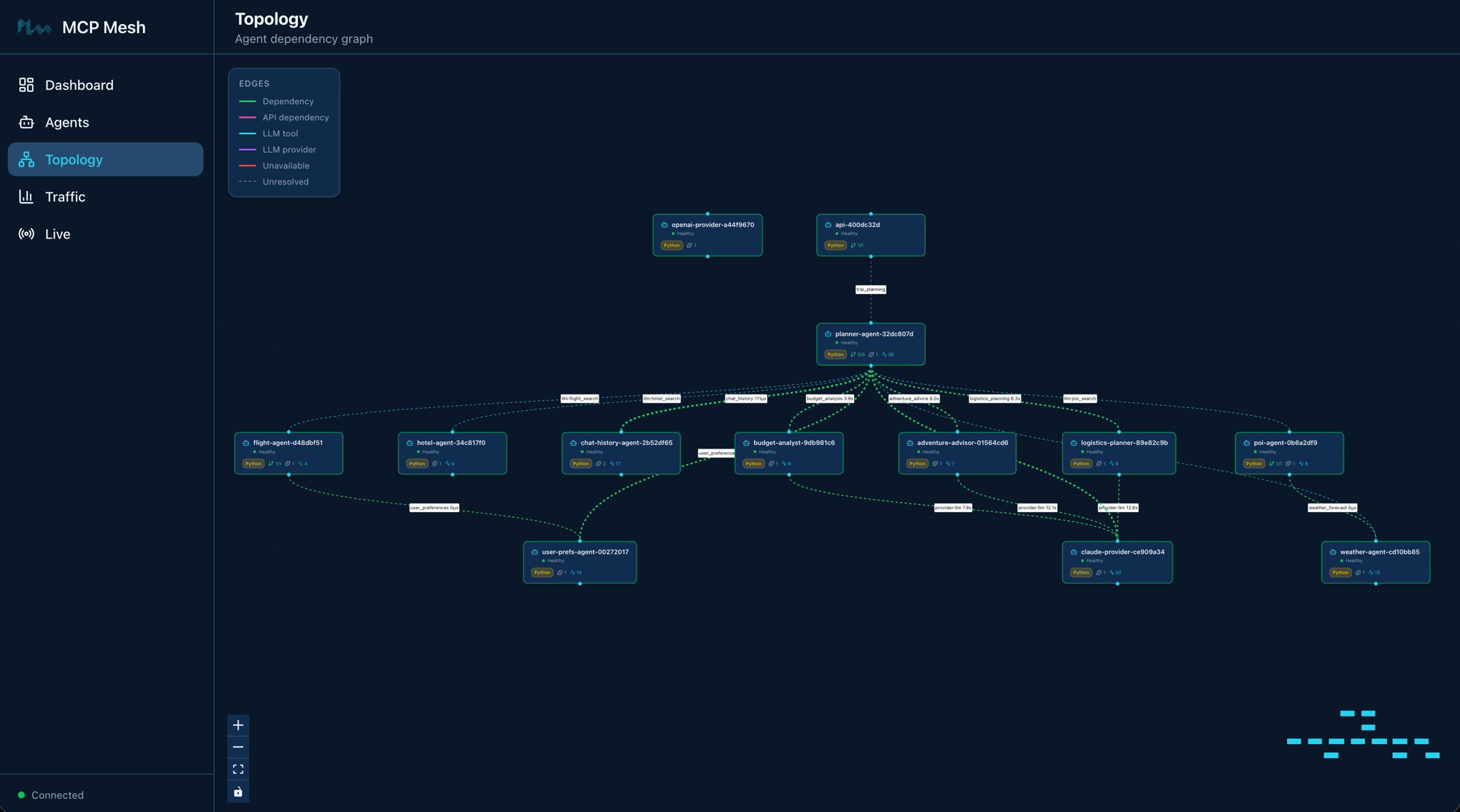
Thirteen agents. Everything from Day 6 plus three specialists in gold. The planner generates a base itinerary, then fans out to three specialist LLM agents in parallel. Each specialist returns structured data -- a Pydantic model -- which the planner synthesizes into the final response.
Today has five parts:
- Structured outputs -- Pydantic return types on
@mesh.llmagents - Build the specialists -- scaffold three LLM agents with structured outputs
- Update the planner -- add committee dependencies and parallel fan-out
- Start and test -- launch 13 agents, call the planner, see enhanced results
- Walk the trace -- fan-out trace showing the planner calling specialists in parallel
Part 1: Structured outputs
When an @mesh.llm function returns str, the LLM's text response passes through as-is. When it returns a Pydantic BaseModel, mesh instructs the LLM to produce JSON matching the schema and validates the response automatically. No special parameter needed -- the return type annotation controls format.
Here is the budget specialist's output model:
class BudgetAnalysis(BaseModel):
    """Structured budget analysis returned by the specialist."""

    total_estimated: int = Field(..., description="Total estimated cost in USD")
    savings_tips: list[str] = Field(
        default_factory=list, description="Actionable tips to save money"
    )
    budget_breakdown: list[dict] = Field(
        default_factory=list,
        description="Cost breakdown by category (flights, hotels, food, activities)",
    )
The BudgetAnalysis model has three fields: total_estimated (an integer), savings_tips (a list of strings), and budget_breakdown (a list of dicts with per-category costs). When the LLM returns, mesh validates the response against this schema. If the LLM produces invalid JSON, mesh retries automatically.
The same pattern applies to the other two specialists. Each defines its own Pydantic model with fields specific to its domain.
Part 2: Build the specialists
Budget analyst
Scaffold the agent:
Created agent 'budget-analyst' in budget-analyst/

Generated files:
  budget-analyst/
  ├── .dockerignore
  ├── Dockerfile
  ├── README.md
  ├── __init__.py
  ├── __main__.py
  ├── helm-values.yaml
  ├── main.py
  ├── prompts/
  │   └── budget-analyst.jinja2
  └── requirements.txt
Replace main.py with:
import mesh
from fastmcp import FastMCP
from pydantic import BaseModel, Field

app = FastMCP("Budget Analyst")


class BudgetAnalysis(BaseModel):
    """Structured budget analysis returned by the specialist."""

    total_estimated: int = Field(..., description="Total estimated cost in USD")
    savings_tips: list[str] = Field(
        default_factory=list, description="Actionable tips to save money"
    )
    budget_breakdown: list[dict] = Field(
        default_factory=list,
        description="Cost breakdown by category (flights, hotels, food, activities)",
    )


@app.tool()
@mesh.llm(
    system_prompt="file://prompts/budget_analysis.j2",
    context_param="ctx",
    provider={"capability": "llm"},
    max_iterations=1,
)
@mesh.tool(
    capability="budget_analysis",
    description="Analyze trip costs and provide budget optimization advice",
    tags=["specialist", "budget", "llm"],
)
def budget_analysis(
    destination: str,
    plan_summary: str,
    budget: str,
    ctx: dict = None,
    llm: mesh.MeshLlmAgent = None,
) -> BudgetAnalysis:
    """Analyze a trip plan and produce a structured budget breakdown."""
    return llm(
        f"Analyze the budget for a trip to {destination} with budget {budget}. "
        f"Plan summary:\n{plan_summary}"
    )


@mesh.agent(
    name="budget-analyst",
    version="1.0.0",
    description="TripPlanner budget analysis specialist (Day 7)",
    http_port=9110,
    enable_http=True,
    auto_run=True,
)
class BudgetAnalystAgent:
    pass
The function takes destination, plan_summary, and budget as input. It calls the LLM with a single prompt, and the return type BudgetAnalysis tells mesh to validate the response as structured JSON. The max_iterations=1 setting means no tool loop -- the specialist makes one LLM call and returns.
Replace the prompt template at prompts/budget_analysis.j2:
You are a travel budget analyst. Given a trip plan and budget, produce a
detailed cost breakdown and money-saving tips.

Destination: {{ destination }}
Budget: {{ budget }}

Plan Summary:
{{ plan_summary }}

Instructions:
- Estimate costs for flights, hotels, food, local transport, and activities.
- Compare estimated total against the stated budget.
- Suggest at least three concrete ways to reduce costs.
- Return your analysis as structured JSON matching the BudgetAnalysis schema.
Adventure advisor
Scaffold:
Replace main.py:
import mesh
from fastmcp import FastMCP
from pydantic import BaseModel, Field

app = FastMCP("Adventure Advisor")


class AdventureAdvice(BaseModel):
    """Structured adventure recommendations returned by the specialist."""

    unique_experiences: list[dict] = Field(
        default_factory=list,
        description="Unique experiences with name, description, and why_special fields",
    )
    local_gems: list[str] = Field(
        default_factory=list, description="Hidden local spots most tourists miss"
    )
    off_beaten_path: str = Field(
        ..., description="A paragraph about unconventional things to do"
    )


@app.tool()
@mesh.llm(
    system_prompt="file://prompts/adventure_advice.j2",
    context_param="ctx",
    provider={"capability": "llm"},
    max_iterations=1,
)
@mesh.tool(
    capability="adventure_advice",
    description="Suggest unique experiences and hidden gems for a destination",
    tags=["specialist", "adventure", "llm"],
)
def adventure_advice(
    destination: str,
    plan_summary: str,
    ctx: dict = None,
    llm: mesh.MeshLlmAgent = None,
) -> AdventureAdvice:
    """Recommend unique experiences and hidden gems for a trip."""
    return llm(
        f"Suggest unique adventures and hidden gems in {destination}. "
        f"Plan summary:\n{plan_summary}"
    )


@mesh.agent(
    name="adventure-advisor",
    version="1.0.0",
    description="TripPlanner adventure advice specialist (Day 7)",
    http_port=9111,
    enable_http=True,
    auto_run=True,
)
class AdventureAdvisorAgent:
    pass
The AdventureAdvice model returns unique_experiences (list of dicts with name, description, and why_special), local_gems (list of strings), and off_beaten_path (a paragraph of text).
Replace the prompt at prompts/adventure_advice.j2:
You are a travel adventure specialist who knows every destination's hidden
gems, off-the-beaten-path experiences, and unique local culture.

Destination: {{ destination }}

Plan Summary:
{{ plan_summary }}

Instructions:
- Suggest at least three unique experiences with a name, description, and
  why_special explanation for each.
- List hidden local spots that most tourists miss.
- Write a short paragraph about unconventional things to do in the area.
- Return your recommendations as structured JSON matching the AdventureAdvice
  schema.
Logistics planner
Scaffold:
Replace main.py:
import mesh
from fastmcp import FastMCP
from pydantic import BaseModel, Field

app = FastMCP("Logistics Planner")


class LogisticsPlan(BaseModel):
    """Structured logistics plan returned by the specialist."""

    daily_schedule: list[dict] = Field(
        default_factory=list,
        description="Day-by-day schedule with times, locations, and transit notes",
    )
    transit_tips: list[str] = Field(
        default_factory=list, description="Local transport tips and passes to buy"
    )
    time_optimization: str = Field(
        ..., description="Advice on minimizing travel time between locations"
    )


@app.tool()
@mesh.llm(
    system_prompt="file://prompts/logistics_plan.j2",
    context_param="ctx",
    provider={"capability": "llm"},
    max_iterations=1,
)
@mesh.tool(
    capability="logistics_planning",
    description="Plan daily logistics, transit routes, and time optimization",
    tags=["specialist", "logistics", "llm"],
)
def logistics_planning(
    destination: str,
    plan_summary: str,
    dates: str,
    ctx: dict = None,
    llm: mesh.MeshLlmAgent = None,
) -> LogisticsPlan:
    """Produce a logistics plan with daily schedules and transit advice."""
    return llm(
        f"Create a logistics plan for {destination} from {dates}. "
        f"Plan summary:\n{plan_summary}"
    )


@mesh.agent(
    name="logistics-planner",
    version="1.0.0",
    description="TripPlanner logistics planning specialist (Day 7)",
    http_port=9112,
    enable_http=True,
    auto_run=True,
)
class LogisticsPlannerAgent:
    pass
The LogisticsPlan model returns daily_schedule, transit_tips, and time_optimization. Each specialist follows the same pattern: define a Pydantic model, write a Jinja prompt, return the model type from the function.
Replace the prompt at prompts/logistics_plan.j2:
You are a travel logistics expert who optimizes daily schedules, transit
routes, and time management for travelers.

Destination: {{ destination }}
Dates: {{ dates }}

Plan Summary:
{{ plan_summary }}

Instructions:
- Create a day-by-day schedule with specific times for each activity.
- Include transit details between locations (walking, subway, bus, taxi).
- Suggest transit passes or cards that save money and time.
- Provide advice on minimizing travel time between locations.
- Return your plan as structured JSON matching the LogisticsPlan schema.
Part 3: Update the planner
The planner needs two changes: declare the specialist capabilities as dependencies, and fan out to them after generating the base plan.
Add dependencies
The @mesh.tool decorator now lists four dependencies instead of one:
@mesh.tool(
    capability="trip_planning",
    description="Generate a trip itinerary using an LLM with real travel data",
    tags=["planner", "travel", "llm"],
    dependencies=[
        "user_preferences",
        "chat_history",
        "budget_analysis",
        "adventure_advice",
        "logistics_planning",
    ],
)
Mesh resolves each capability to an McpMeshTool proxy. The planner function signature gains three new parameters -- budget_analyst, adventure_advisor, and logistics_planner -- each injected automatically by mesh.
Fan out with asyncio.gather
After the LLM generates a base plan, the planner calls all three specialists in parallel:
    # Fan out to specialist agents in parallel
    specialist_tasks = []
    if budget_analyst:
        specialist_tasks.append(
            budget_analyst(
                destination=destination, plan_summary=str(base_plan), budget=budget
            )
        )
    if adventure_advisor:
        specialist_tasks.append(
            adventure_advisor(destination=destination, plan_summary=str(base_plan))
        )
    if logistics_planner:
        specialist_tasks.append(
            logistics_planner(
                destination=destination, plan_summary=str(base_plan), dates=dates
            )
        )

    if specialist_tasks:
        specialist_results = await asyncio.gather(*specialist_tasks)

        # Synthesize specialist insights into the final plan
        sections = [str(base_plan), "\n---\n## Specialist Insights\n"]
        labels = []
        if budget_analyst:
            labels.append("Budget Analysis")
        if adventure_advisor:
            labels.append("Adventure Recommendations")
        if logistics_planner:
            labels.append("Logistics Plan")

        for label, result in zip(labels, specialist_results):
            sections.append(f"\n### {label}\n{result}\n")

        final_result = "\n".join(sections)
    else:
        final_result = str(base_plan)
Each specialist receives the destination and the base plan summary. The planner waits for all three to complete, then appends their insights to the response. Because each specialist is an independent LLM call with max_iterations=1, they run concurrently without interference.
Full updated planner
Here is the complete updated main.py:
import asyncio

import mesh
from fastmcp import FastMCP
from mesh import MeshContextModel
from pydantic import Field

app = FastMCP("Planner Agent")


class TripRequest(MeshContextModel):
    """Context model for the trip planning prompt template."""

    destination: str = Field(..., description="Travel destination city")
    dates: str = Field(..., description="Travel dates (e.g. June 1-5, 2026)")
    budget: str = Field(..., description="Total trip budget (e.g. $2000)")
    user_preferences: str = Field(
        default="", description="User travel preferences (injected at runtime)"
    )


@app.tool()
@mesh.llm(
    system_prompt="file://prompts/plan_trip.j2",
    context_param="ctx",
    provider={"capability": "llm", "tags": ["+claude"]},
    filter=[
        {"capability": "flight_search"},
        {"capability": "hotel_search"},
        {"capability": "weather_forecast"},
        {"capability": "poi_search"},
    ],
    filter_mode="all",
    max_iterations=10,
)
@mesh.tool(
    capability="trip_planning",
    description="Generate a trip itinerary using an LLM with real travel data",
    tags=["planner", "travel", "llm"],
    dependencies=[
        "user_preferences",
        "chat_history",
        "budget_analysis",
        "adventure_advice",
        "logistics_planning",
    ],
)
async def plan_trip(
    destination: str,
    dates: str,
    budget: str,
    message: str = "",
    session_id: str = "",
    conversation_history: list[dict] = [],
    user_prefs: mesh.McpMeshTool = None,
    chat_history: mesh.McpMeshTool = None,
    budget_analyst: mesh.McpMeshTool = None,
    adventure_advisor: mesh.McpMeshTool = None,
    logistics_planner: mesh.McpMeshTool = None,
    ctx: TripRequest = None,
    llm: mesh.MeshLlmAgent = None,
) -> str:
    """Plan a trip given a destination, dates, and budget."""
    # Tier-1: prefetch user preferences before the LLM call
    prefs = {}
    if user_prefs:
        prefs = await user_prefs(user_id="demo-user")

    # Inject preferences into the context so the Jinja template can use them
    prefs_summary = (
        f"Preferred airlines: {', '.join(prefs.get('preferred_airlines', []))}. "
        f"Budget limit: ${prefs.get('budget_usd', 'flexible')}. "
        f"Interests: {', '.join(prefs.get('interests', []))}. "
        f"Minimum hotel stars: {prefs.get('hotel_min_stars', 'any')}."
        if prefs
        else "No user preferences available."
    )

    # Tier-1: fetch chat history if a session is active
    history = []
    if session_id and chat_history:
        history = await chat_history.call_tool("get_history", {
            "session_id": session_id,
            "limit": 20,
        })
        if isinstance(history, dict):
            history = history.get("result", [])

    # Build the message for the LLM. When history is present,
    # pass the full turn list so the LLM sees prior context.
    user_text = message or (
        f"Plan a trip to {destination} from {dates} with a budget of {budget}."
    )

    if history:
        messages = list(history)
        messages.append({"role": "user", "content": user_text})
        base_plan = await llm(
            messages,
            context={"user_preferences": prefs_summary},
        )
    else:
        base_plan = await llm(
            user_text,
            context={"user_preferences": prefs_summary},
        )

    # Fan out to specialist agents in parallel
    specialist_tasks = []
    if budget_analyst:
        specialist_tasks.append(
            budget_analyst(
                destination=destination, plan_summary=str(base_plan), budget=budget
            )
        )
    if adventure_advisor:
        specialist_tasks.append(
            adventure_advisor(destination=destination, plan_summary=str(base_plan))
        )
    if logistics_planner:
        specialist_tasks.append(
            logistics_planner(
                destination=destination, plan_summary=str(base_plan), dates=dates
            )
        )

    if specialist_tasks:
        specialist_results = await asyncio.gather(*specialist_tasks)

        # Synthesize specialist insights into the final plan
        sections = [str(base_plan), "\n---\n## Specialist Insights\n"]
        labels = []
        if budget_analyst:
            labels.append("Budget Analysis")
        if adventure_advisor:
            labels.append("Adventure Recommendations")
        if logistics_planner:
            labels.append("Logistics Plan")

        for label, result in zip(labels, specialist_results):
            sections.append(f"\n### {label}\n{result}\n")

        final_result = "\n".join(sections)
    else:
        final_result = str(base_plan)

    # Save turns to chat history so the next request sees them
    if session_id and chat_history:
        await chat_history.call_tool("save_turn", {
            "session_id": session_id,
            "role": "user",
            "content": user_text,
        })
        response_text = final_result if isinstance(final_result, str) else str(final_result)
        await chat_history.call_tool("save_turn", {
            "session_id": session_id,
            "role": "assistant",
            "content": response_text,
        })

    return final_result


@mesh.agent(
    name="planner-agent",
    version="1.0.0",
    description="TripPlanner LLM planner with committee of specialists (Day 7)",
    http_port=9107,
    enable_http=True,
    auto_run=True,
)
class PlannerAgent:
    pass
The planner's description changes to reflect its new role as coordinator. The core LLM call is unchanged -- it still generates the base itinerary using flight, hotel, weather, and POI data. The committee adds depth without replacing the original planning logic.
Part 4: Start and test
Start the specialist agents
Your ten agents from Day 6 should still be running. Add the three specialists:
$ meshctl start --dte --debug -d -w \
    budget-analyst/main.py \
    adventure-advisor/main.py \
    logistics-planner/main.py
If you are starting fresh, launch everything at once:
$ meshctl start --dte --debug -d -w \
    budget-analyst/main.py \
    adventure-advisor/main.py \
    logistics-planner/main.py \
    claude-provider/main.py \
    openai-provider/main.py \
    flight-agent/main.py \
    hotel-agent/main.py \
    weather-agent/main.py \
    poi-agent/main.py \
    user-prefs-agent/main.py \
    chat-history-agent/main.py \
    planner-agent/main.py \
    gateway/main.py
Check the mesh:
Registry: running (http://localhost:8000) - 13 healthy

NAME                             RUNTIME   TYPE    STATUS    DEPS   ENDPOINT           AGE   LAST SEEN
adventure-advisor-7c4e2f1a       Python    Agent   healthy   0/0    10.0.0.74:9111     8s    2s
budget-analyst-5a1d3b8e          Python    Agent   healthy   0/0    10.0.0.74:9110     8s    2s
chat-history-agent-3f2a1b9c      Python    Agent   healthy   0/0    10.0.0.74:9109     20m   2s
claude-provider-0a89e8c6         Python    Agent   healthy   0/0    10.0.0.74:49486    35m   2s
flight-agent-a939da4b            Python    Agent   healthy   1/1    10.0.0.74:49480    35m   2s
gateway-7b3f2e91                 Python    API     healthy   1/1    10.0.0.74:8080     25m   2s
hotel-agent-9932ac09             Python    Agent   healthy   0/0    10.0.0.74:49482    35m   2s
logistics-planner-9f6b4d2c       Python    Agent   healthy   0/0    10.0.0.74:9112     8s    2s
openai-provider-40a5c637         Python    Agent   healthy   0/0    10.0.0.74:49485    35m   2s
planner-agent-fb07b918           Python    Agent   healthy   5/5    10.0.0.74:49484    35m   2s
poi-agent-97bd9fcc               Python    Agent   healthy   1/1    10.0.0.74:49481    35m   2s
user-prefs-agent-87506c4a        Python    Agent   healthy   0/0    10.0.0.74:49479    35m   2s
weather-agent-a6f7ea5e           Python    Agent   healthy   0/0    10.0.0.74:49483    35m   2s
Thirteen agents. The planner now shows 5/5 dependencies -- user_preferences, chat_history, plus the three specialist capabilities.
List the tools:
TOOL                      AGENT                            CAPABILITY           TAGS
-----------------------------------------------------------------------------------------------
adventure_advice          adventure-advisor-7c4e2f1a       adventure_advice     specialist,adventure,llm
budget_analysis           budget-analyst-5a1d3b8e          budget_analysis      specialist,budget,llm
claude_provider           claude-provider-0a89e8c6         llm                  claude
flight_search             flight-agent-a939da4b            flight_search        flights,travel
get_history               chat-history-agent-3f2a1b9c      chat_history         chat,history,state
get_user_prefs            user-prefs-agent-87506c4a        user_preferences     preferences,travel
get_weather               weather-agent-a6f7ea5e           weather_forecast     weather,travel
hotel_search              hotel-agent-9932ac09             hotel_search         hotels,travel
logistics_planning        logistics-planner-9f6b4d2c       logistics_planning   specialist,logistics,llm
openai_provider           openai-provider-40a5c637         llm                  openai,gpt
plan_trip                 planner-agent-fb07b918           trip_planning        planner,travel,llm
save_turn                 chat-history-agent-3f2a1b9c      chat_history         chat,history,state
search_pois               poi-agent-97bd9fcc               poi_search           poi,travel

13 tool(s) found
Three new specialist tools: budget_analysis, adventure_advice, and logistics_planning.
Call the planner
$ curl -s -X POST http://localhost:8080/plan \
    -H "Content-Type: application/json" \
    -H "X-Session-Id: test-session-day7" \
    -d '{"destination":"Kyoto","dates":"June 1-5, 2026","budget":"$2000"}'
The response now includes the base itinerary followed by specialist insights:
{
  "result": "## Kyoto Trip Itinerary: June 1-5, 2026\n\n**Budget: $2,000**\n\n### Day 1 (June 1) - Arrival & Eastern Kyoto\n...\n\n---\n## Specialist Insights\n\n### Budget Analysis\n{\"total_estimated\": 1847, \"savings_tips\": [\"Book flights 3 weeks in advance for 15% savings\", \"Use a Kyoto Bus Day Pass ($6/day) instead of taxis\", \"Eat at konbini (convenience stores) for 2 meals/day to save $30/day\"], \"budget_breakdown\": [{\"category\": \"flights\", \"amount\": 901}, {\"category\": \"hotels\", \"amount\": 380}, {\"category\": \"food\", \"amount\": 300}, {\"category\": \"activities\", \"amount\": 150}, {\"category\": \"transport\", \"amount\": 116}]}\n\n### Adventure Recommendations\n{\"unique_experiences\": [{\"name\": \"Fushimi Inari at dawn\", \"description\": \"Hike the thousand torii gates before 6am when the shrine is empty\", \"why_special\": \"Most tourists arrive after 9am — the early morning light through the gates is unforgettable\"}, ...], \"local_gems\": [\"Nishiki Market back alleys\", \"Philosopher's Path at sunset\", \"Tofuku-ji moss garden\"], \"off_beaten_path\": \"Skip the tourist-heavy Arashiyama bamboo grove midday. Instead, rent a bicycle and ride along the Kamo River to the northern temples...\"}\n\n### Logistics Plan\n{\"daily_schedule\": [{\"day\": 1, \"activities\": [{\"time\": \"14:00\", \"activity\": \"Arrive KIX\", \"transit\": \"Haruka Express to Kyoto Station (75 min, ¥3,430)\"}]}, ...], \"transit_tips\": [\"Buy an ICOCA card at the airport for all local transit\", \"Kyoto Bus Day Pass (¥700) covers most tourist routes\", \"Walk between eastern Higashiyama temples — they are within 15 minutes of each other\"], \"time_optimization\": \"Group attractions by neighborhood to minimize transit. Eastern Kyoto (Kiyomizu, Gion, Philosopher's Path) in one day, western Kyoto (Arashiyama, Kinkaku-ji) in another.\"}",
  "session_id": "test-session-day7"
}
The base plan covers flights, hotels, and a day-by-day itinerary. Below the separator, three specialist sections provide targeted insights: a cost breakdown with savings tips, adventure recommendations with hidden gems, and a logistics plan with transit details. Each section is structured JSON that your frontend can parse and display however you like.
Part 5: Walk the trace
Open the mesh UI:
Navigate to http://localhost:3080 and click the most recent trace. The call tree shows the fan-out pattern:
└─ plan_trip (planner-agent) [42871ms] ✓
   ├─ get_history (chat-history-agent) [2ms] ✓
   ├─ get_user_prefs (user-prefs-agent) [1ms] ✓
   ├─ claude_provider (claude-provider) [18451ms] ✓
   │  ├─ flight_search (flight-agent) [14ms] ✓
   │  │  └─ get_user_prefs (user-prefs-agent) [0ms] ✓
   │  ├─ hotel_search (hotel-agent) [1ms] ✓
   │  ├─ get_weather (weather-agent) [0ms] ✓
   │  └─ search_pois (poi-agent) [21ms] ✓
   │     └─ get_weather (weather-agent) [0ms] ✓
   ├─ budget_analysis (budget-analyst) [8204ms] ✓    ← parallel
   ├─ adventure_advice (adventure-advisor) [7891ms] ✓ ← parallel
   ├─ logistics_planning (logistics-planner) [8102ms] ✓ ← parallel
   ├─ save_turn (chat-history-agent) [1ms] ✓
   └─ save_turn (chat-history-agent) [1ms] ✓
The planner first generates the base plan (18s via Claude with tool calls), then fans out to the three specialists in parallel (~8s each, overlapping). Total wall-clock time for the specialists is about 8 seconds, not 24 -- they run concurrently via asyncio.gather. Each specialist makes its own LLM call through the shared claude-provider.
Structured outputs are validated at the edge
Each specialist's Pydantic model acts as a contract. If a specialist's LLM response does not match the schema, mesh retries the call automatically. The planner receives validated data every time -- no defensive parsing needed. This is especially useful when specialists are developed by different teams: the model definition is the API contract.
Stop and clean up
On Day 8 you'll containerize the entire mesh with Docker Compose — local agents need to stop so Docker can use the same ports.
Troubleshooting
Specialist dependency not resolved. The planner shows 3/4 or fewer deps in meshctl list. Make sure all three specialist agents started successfully:
If a specialist is missing, check its logs:
Common cause: the prompt template file path is wrong. The file:// path in @mesh.llm is relative to the agent's working directory. Verify the prompts/ directory exists next to main.py.
Specialist returns raw text instead of JSON. The Pydantic return type requires the LLM to produce valid JSON. If the LLM ignores the schema instruction, check that max_iterations=1 is set and the prompt explicitly asks for JSON output. Mesh retries once on validation failure, but a fundamentally broken prompt will still fail.
asyncio.gather raises an exception from one specialist. If one specialist fails, asyncio.gather raises the first exception and cancels the others. This is Python's default behavior. For production, consider wrapping each call in a try/except or using asyncio.gather(*tasks, return_exceptions=True) to collect partial results.
Timeouts on specialist calls. Each specialist makes an LLM call. If your provider is rate-limited, three parallel calls may hit the limit. Check your API key's rate limits. As a fallback, you can call specialists sequentially instead of with asyncio.gather.
Recap
You added a committee of three specialist agents to the trip planner. Each specialist is an independent @mesh.llm agent with a Pydantic return type for structured output. The planner declares them as dependencies, calls them in parallel with asyncio.gather, and synthesizes their insights into the final response. No framework changes needed -- the same dependency injection and LLM patterns you learned on Day 3 scale to multi-agent fan-out.
See also
meshctl man decorators-- the@mesh.tooland@mesh.llmdecorator referencemeshctl man structured-output-- Pydantic return types and JSON validationmeshctl man dependency-injection-- how DI resolves multi-capability dependencies
Next up
Day 8 containerizes the mesh -- all thirteen agents in a single Docker Compose file with health checks and log aggregation.